















What is poka-yoke?
Poka-yoke (ポカヨケ) is Japanese for avoiding (yokeru) inadvertent mistakes (poka). Shigeo Shingo devised the principle at Toyota in the 1960s. The idea: don't ask people to pay more attention, but design the product or process so that an error is impossible or immediately noticeable.
You encounter examples of poka-yoke everywhere: a SIM card with a chamfered corner, an earthed plug, a USB-C plug that you cannot insert incorrectly into the port. That last example shows there are two ways to make a connection error-proof:
| Approach | What it does | Example |
|---|---|---|
| Making the error impossible | Incorrect assembly is prevented. | The corner of a SIM card, or a pin that hits solid sheet material instead of a slot. |
| Ensuring the error doesn't matter | Any way it fits is correct. | A USB-C plug, or a symmetrical part with a symmetrical connection. |
If possible, the second approach is best: then no one needs to search for the correct orientation. A sticker, part number, or manual doesn't fit either approach, because someone still has to pay attention and read. Only use these in places where poka-yoke isn't feasible.
Laser cutting is ideal for poka-yoking your design
With a laser cutter, a different shape costs nothing extra: no new tools, no setup time. Shifting a pin by twenty millimetres is free. For parts made from sheet material, poka-yoke can therefore be included in the design as standard.
It pays off as soon as someone other than the designer assembles it: on an assembly line, for a flat-packed kit, with a colleague in the workshop. Or for yourself, if you revisit the design three weeks later.
Practical example: 50 parts that fit anywhere
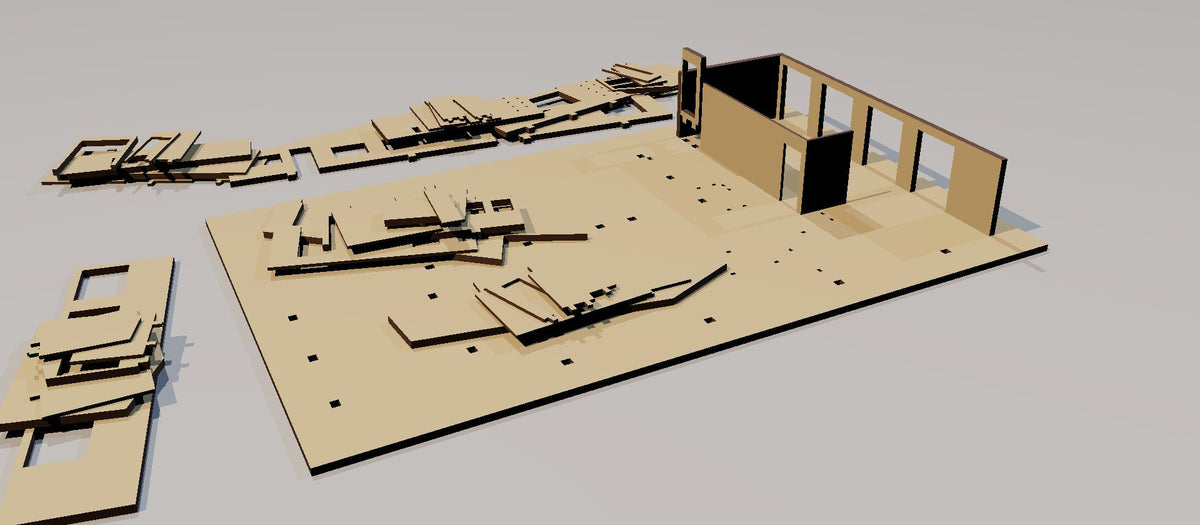
We built a 1:25 scale model ourselves from birch plywood: fifty parts, with 9 mm and 4 mm thick walls that insert with pins into slots of a base plate and a floor plate. This is a mortise and tenon joint, often called a finger joint in laser cutting. Each wall had identical pins, evenly distributed.

Assembly became a puzzle, as you couldn't deduce anything from the connections themselves. Afterwards, we measured the pin positions of the 33 walls with two or more pins. What we found:
- 20 walls also fitted into the slots of a completely different wall;
- 17 walls fitted backwards into their own slots.
The four basic patterns

- Two identical pins, off-centre. Incorrect. It looks asymmetrical and therefore seems safe, but you can turn the panel around and it will still fit.
- Equal distance left and right. Good for a part that is also symmetrical itself: when rotated, it will be in exactly the same position.
- Symmetrical, but with a different spacing. Good. This prevents part 2 and 3 from being interchanged.
- Unequal spacings. Good for asymmetrical parts. It only fits one way, so the front and back are fixed.
Why two identical pins never determine an orientation
Two pins have only one spacing, and it's the same when viewed from both sides. If you turn the wall around, the pins will still fall into both slots. The wall is just shifted, and the doorway is suddenly on the wrong side.

Sometimes an adjacent part will block the shifted wall, but don't count on it. Usually, you only notice it once the glue is already applied ;).
Six golden rules for design
- Symmetrical part? Symmetrical connection. If it doesn't matter how you rotate the part, position the pins at an equal distance from both ends. Then there's no wrong way.
- Asymmetrical part? Then an asymmetrical pattern. Choose a pin pattern that is not its own mirror image. Standard options include three identical pins at unequal distances (pattern 4).
- Maximise the differences. Give each part its own pattern that deviates as much as possible from the rest. Don't look for the smallest difference that just blocks it, but a difference you can spot from a distance: for one part, two pins close together at the end, for another, in the middle. Then you'll know which part you're holding before you try to fit it. Note: a pattern and its mirror image count as the same, because a mirrored part will still fit when reversed.
- Give identical parts the same pattern. If two parts are exactly alike, interchanging them is not a mistake. So make them intentionally interchangeable.
- Use material thickness. A 9 mm pin won't fit into a 4 mm slot. The other way around, it will fit, but with a lot of play.
- Check systematically, not by eye. With thirty parts, no one can oversee all combinations anymore. Digitally test each part in every row of slots, in both directions, and note every place where all pins find a slot.

Which coding do you choose?
You can make a pin pattern unique in several ways. They don't all work equally well:
| Coding | Prevents reversal? | Prevents interchanging? | Application |
|---|---|---|---|
| Three identical pins with two different spacings per part | Yes | Yes, in both directions | Standard |
| One narrow and one wide pin (fixed sizes) with a unique spacing | Yes | Yes, if the spacings vary more than the difference in pin width | For short parts (where three pins don't fit) |
| Two pins where one has a different length per part | Yes | Only in one direction: a shorter pin still fits into a longer slot | Avoid |
| Three equally spaced pins with a different length for the middle pin per part | No, the pattern remains symmetrical | Only in one direction | Avoid |
The lesson from this table: code with position, not length. A pin in the wrong place will hit solid sheet material and thus block in two directions: A won't fit into B, and B won't fit into A. A pin with a differing length only blocks one way: too long won't fit, but too short will fall in with some play. With identical pins, you also maintain the same fit everywhere, and a shifted pin is much easier to spot than a pin that is two millimetres longer.
With three identical pins, the problem of a pin being too short doesn't exist, as there are no longer slots for them to fall into. And you have two spacings to vary instead of one. This allows for many more possible patterns, which are also further apart.
Is a part too short for three pins? Then use one narrow and one wide pin, for example, 1 and 1.5 times the normal width. Keep these two dimensions consistent throughout the design and vary only the spacing.

What it achieved for the model
For our model, 13 symmetrical walls remained symmetrical. The others received their own coding: 11 walls with three or four identical pins in unique positions, and 9 shorter walls with one narrow and one wide pin.

Now, 30 of the 33 walls have only one possible position and one orientation, and no wall fits backwards anymore. The three exceptions are very short walls of 26, 51, and 86 mm, where there is no room for a clearly distinct spacing. These will receive an engraved part code. (Note: this is calculated from the pin positions. We have not yet cut a physical model with the new patterns.)
Where poka-yoke ends
- Two pins are vulnerable. A part with two pins will fit into any row of slots where the same spacing coincidentally occurs, even if that row has three slots. Use three pins as soon as there is space and check for exceptions.
- One pin fixes nothing. A part with one pin can also be assembled inverted.
- Small parts remain tricky. Sometimes a part is too short. Only then do you fall back on an engraved code.
- Don't confuse fit and poka-yoke. Poka-yoke determines where the pins are located, not how tightly they clamp in the slot.
How to check your design
Perform the check from rule 6 with a script, not by eye. For each part, in both directions, check all rows of slots of the same material thickness to see if every pin falls into a slot. Count a slot that is up to 1 mm too tight as fitting, because in practice someone will push or hammer it in anyway. Only its designated spot should pass the test (and for symmetrical parts, the mirrored spot, or the spot of an identical part). Any other hit is a design flaw that you still need to resolve.
Tip: The same applies to hole patterns. With one unequal distance in a bolt pattern, or one alignment pin off-centre, the position of a lid or front panel is just as fixed.