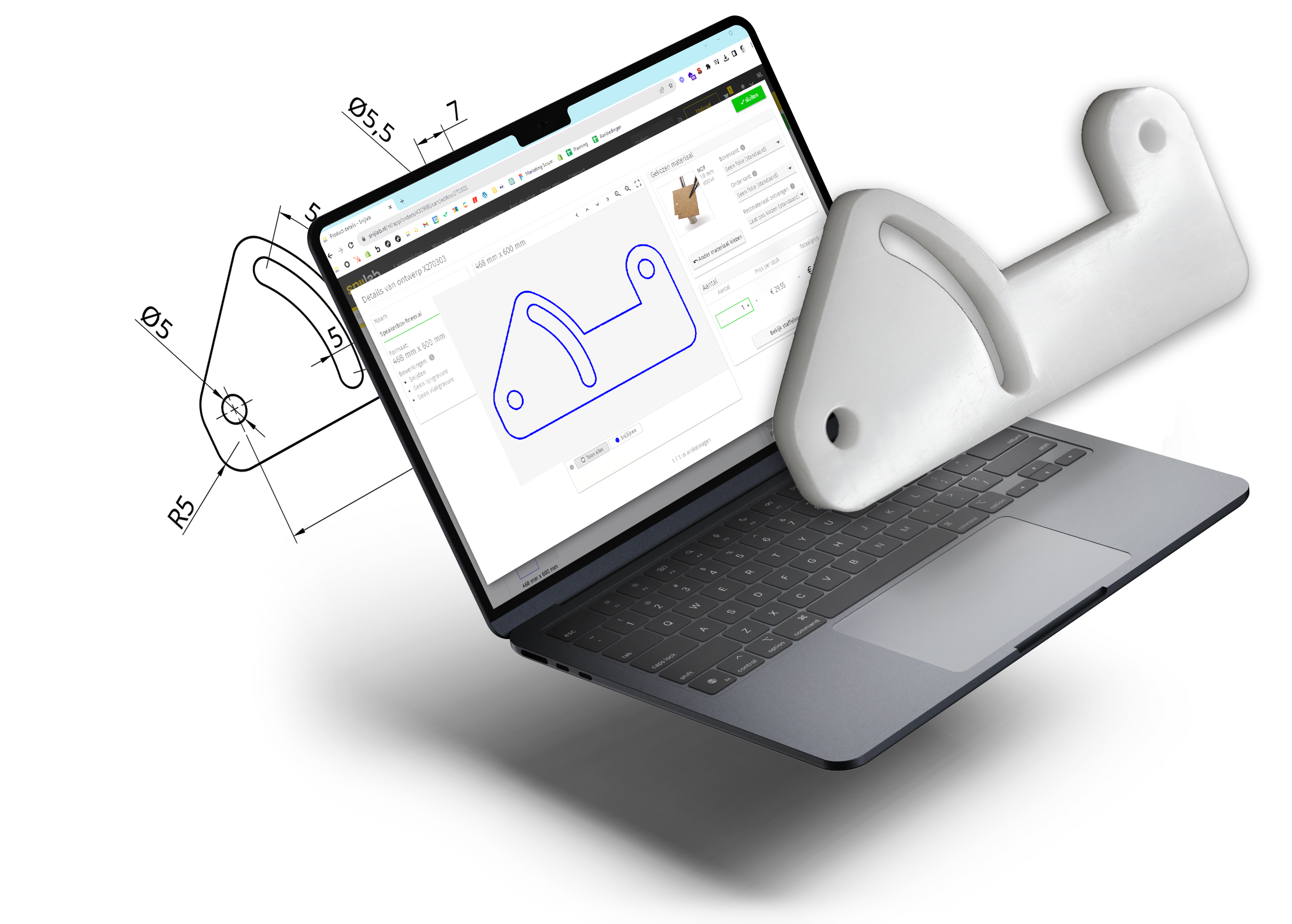






































Laser cutting HDPE sheets for machine parts? Discover when to choose HDPE, how it compares to POM and Acrylic, and why laser cutting is ideal for technical plastics.
When designing machine parts, material choice is crucial. A wrong choice can lead to rapid wear, unexpected breakages or machine downtime. HDPE (High Density Polyethylene) is a versatile technical plastic that performs excellently in many applications, but is it the right choice for your application?
An important advantage of technical plastics like HDPE, POM and Acrylic (also known as plexiglass) is that they are well-suited for laser cutting. This makes them particularly suitable for replacement parts, prototypes and small series. While conventional production techniques require expensive molds to be made first, with laser cutting you work directly from a digital file. The result: no tooling costs, short lead times and the flexibility to implement changes quickly.
In this blog, we compare HDPE with POM and Acrylic, explain when HDPE is the best option, and illustrate this with a practical case from the food industry.
What is HDPE?
HDPE (High Density Polyethylene) is a semi-crystalline thermoplastic with a high density. The material is known for its tough, impact-resistant properties and excellent chemical resistance. Unlike many other plastics, HDPE absorbs almost no moisture and retains its mechanical properties even with long-term use.
Key properties of HDPE:
- Toughness and impact resistance - The material yields under shock loads instead of breaking
- Low friction coefficient - Ideal for sliding movements and contact surfaces
- Chemical resistance - Resistant to most acids, bases and solvents
- Moisture resistance - Absorbs virtually no water (<0.01%)
- Hygienic - Easy to clean, suitable for the food industry
- Cost-effective - Favorable price-performance ratio compared to other technical plastics
HDPE is available in various thicknesses, from thin sheets (3-5mm) to thick sheets (10mm+), making it suitable for diverse applications.
HDPE, POM or Acrylic: which plastic do you choose?
The choice between HDPE, POM and Acrylic depends on the specific requirements of your application. Below, we compare the three materials based on crucial properties.
Comparison table
| Property | HDPE | POM | Acrylic (PMMA) |
|---|---|---|---|
| Toughness | Very tough | Tough | Brittle |
| Impact resistance | Excellent | Good | Moderate to poor |
| Wear resistance | Good | Excellent | Moderate |
| Stiffness | Moderate | High | High |
| Friction coefficient | Low (0.2-0.3) | Very low (0.15-0.25) | Moderate |
| Moisture absorption | <0.01% | 0.2-0.5% | 0.3-0.4% |
| Chemical resistance | Excellent | Good | Moderate |
| Max. operating temperature | 80-90°C | 100-110°C | 70-80°C |
| Price | € | €€€ | €€ |
When do you choose HDPE?
HDPE is the best choice when:
- Your application must withstand shock loads or impact
- The part comes into contact with chemicals or cleaning agents
- Moisture resistance is essential
- You are looking for a good balance between performance and cost
- The part needs to be cleaned regularly (food safety)
- Sliding movements occur with moderate load
Applications: Guides, sorting systems, conveyor belts, protective covers, food contact parts, chemical tanks.
When do you choose POM?
POM (polyacetal) is better suited when:
- Maximum wear resistance and stiffness are required
- The part must maintain high precision and dimensional stability
- High contact pressures occur
- The extra costs are justified by better performance
Applications: Gears, bearings, precision guides, cam plates, valves.
When do you choose Acrylic?
Acrylic (PMMA) is the right choice when:
- Transparency is essential
- The part is mainly statically loaded
- Aesthetics are important (high-gloss finish)
- No shock loads occur
Applications: Protective covers with viewing windows, machine covers, display protection, safety screens.
Note: Acrylic is relatively brittle. For applications with shock loads or where parts may jam, HDPE or POM is a better choice.

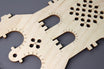
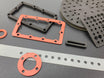
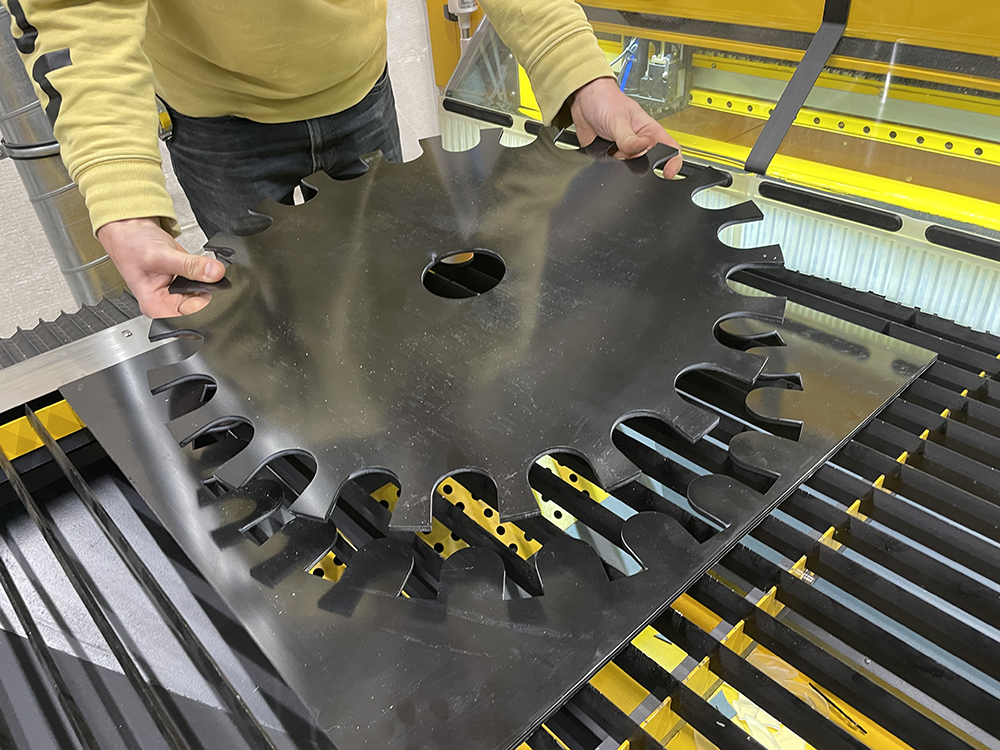
Left: HDPE sorting wheel, right: laser-cut POM parts
Case: A sorting wheel that keeps production running
A practical example at De Veldfabriek illustrates when HDPE is the right material choice and how laser cutting offers a cost-effective solution.
The situation
A production company in the food industry adapted their capping machine for a new bottle format with different caps. The existing sorting disc was designed for a different cap diameter and did not function with the new caps. The alternative - a complete machine upgrade - was costly and unnecessary, as the machine itself functioned perfectly.
The solution
A custom laser-cut sorting wheel made of HDPE was chosen. This part had to meet specific requirements:
Functional requirements:
- Continuous contact with plastic caps (sliding movement)
- Resistant to shock loads when caps jam
- No plastic deformation during long-term use
- Easy to clean (food safety)
Why HDPE?
In this case, a 6mm thick HDPE sheet was chosen. The material choice was based on:
1. Toughness under shock load - When caps jam, HDPE yields without breaking. POM could theoretically also work, but at significantly higher costs without functional advantage. Acrylic was ruled out due to brittleness.
2. Low friction and wear resistance - Caps slide continuously over the surface. HDPE offers a good balance between wear resistance and cost. POM is more wear-resistant, but not necessary for this application.
3. Cleanability - Zero moisture absorption and a smooth surface make HDPE ideal for food contact. The material is easy to clean and meets hygiene requirements.
4. Chemical resistance - Resistant to the cleaning agents and compressed air used.
5. Costs - HDPE offered all necessary properties at a much lower cost than POM.
Production via laser cutting
The sorting wheel was laser-cut directly from HDPE sheet material. This had several advantages:
- No tooling costs for a single piece
- Fast delivery (within a few working days)
- Accurate dimensioning (cut-outs exact to cap diameter)
- Possibility of adjustments if necessary
The result
The new HDPE sorting wheel has been installed and functions correctly. The caps are poured into the bin, and the rotating sorting wheel picks up the caps one by one. Upside-down caps are blown back into the bin by an air jet before they disappear into the cap chute.
This case shows how a relatively simple plastic part, made from the right material and with the right production technique, makes a big difference in operational efficiency.

Design guidelines for HDPE machine parts
If you are considering having a part laser cut from HDPE, please observe the following guidelines:
Wall thickness and stiffness:
- HDPE is less stiff than POM or Acrylic
- Compensate for this with sufficient wall thickness (minimum 5mm for structural parts)
- Reinforcement ribs can help with larger surfaces
Tolerances:
- Laser cutting offers accuracies of ±0.2mm
- Take into account thermal expansion during temperature changes
- HDPE has a higher thermal expansion coefficient than metals
Mounting methods:
- Bolts and nuts work well (use ample drill holes due to expansion)
- Welding is possible with HDPE
- Gluing is difficult (poor adhesion properties)
Surface finish:
- Laser-cut edges are slightly rounded (inherent to the process)
- For critical mating surfaces: post-processing by milling is possible
- No chips or sharp edges after laser cutting
In conclusion
The choice between HDPE, POM and Acrylic for machine parts depends on your specific requirements. HDPE offers an excellent combination of toughness, chemical resistance, and cost-effectiveness. The material is especially suitable for applications with shock loads, sliding movements, and where cleanability is important.
By choosing laser cutting, you also get a fast, flexible production method without tooling costs. Whether it's a replacement part, a prototype, or a small series – HDPE laser cutting offers a practical solution for technical challenges.
Do you have a machine part that needs to be adapted or replaced? Contact us to discuss if HDPE is the right choice for your application. We are happy to help you with material choice, design, and production.