

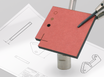
Calculating laser cutting costs is a complex matter. Many factors influence the cost of laser cutting. That's why you often find that laser cutting companies don't list prices online. The price is always calculated specifically for you.
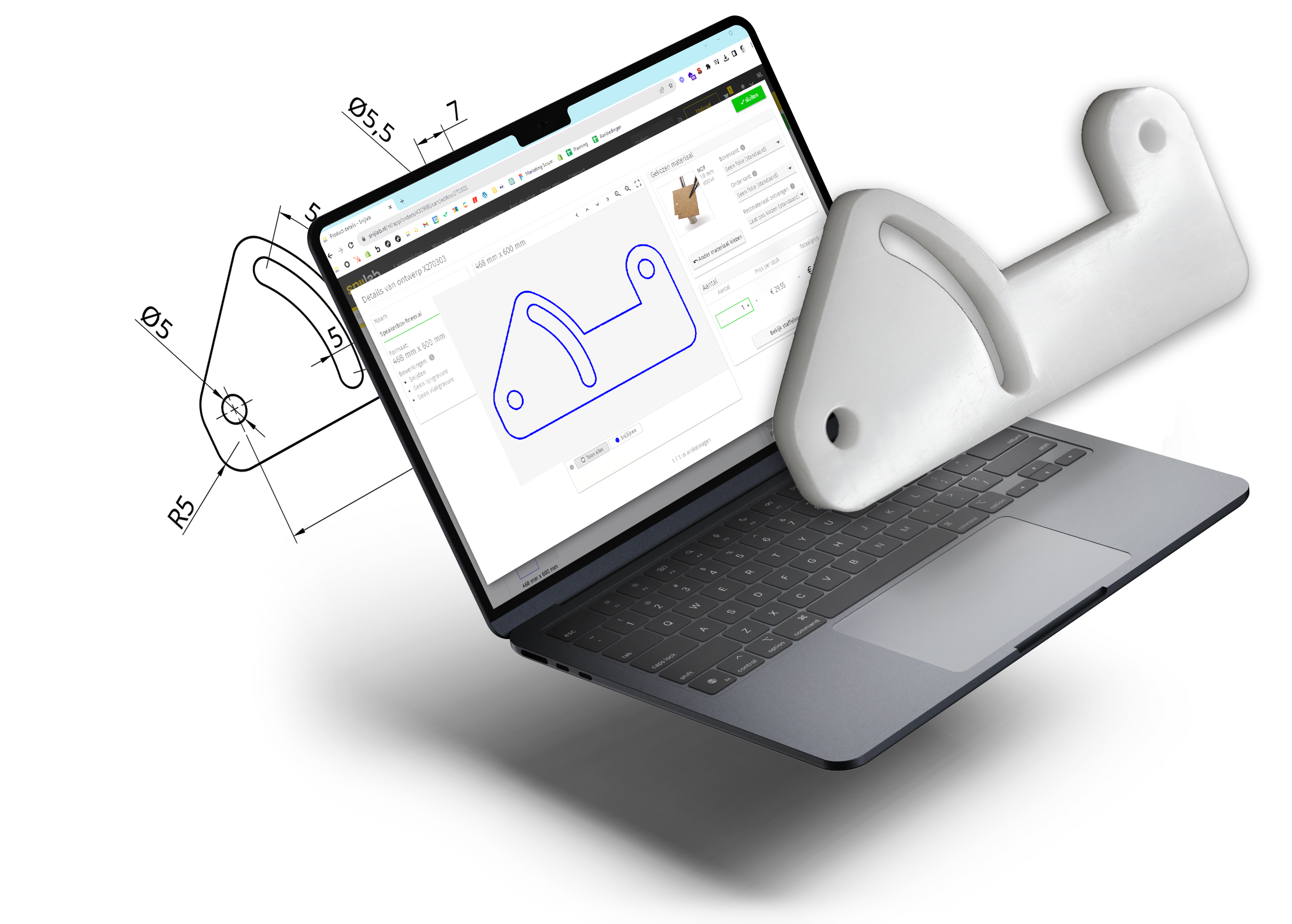
We wanted to offer the fairest possible price and not have to calculate it manually. That's why we created snijlab.nl, where you can upload your drawing and get an automatic price calculation.
In this article, we explain the factors that influence laser cutting costs. We also compare laser cutting costs with other production methods.
What Determines Laser Cutting Costs?
Simplicity/Complexity of the Design
Generally, the simpler your design, the faster it can be produced. This is because you pay for the 'cutting length' – the total length of the line that is cut (or engraved). Based on this, we calculate how much power is consumed to produce your order, which in part determines the production costs.
Material
Material choice plays a role in production time. Thicker, heavier materials simply take more time to cut than thinner ones. For very small designs, this is often less relevant, as setup time plays a larger role there.
Production Time
Since every part is custom-made, production time varies for each part.
Setup Costs
Setup costs also play a role. It's important that your drawing is thoroughly checked to ensure production runs smoothly and no material is wasted. After production, your work must be carefully inspected. For example, for material flaws, sufficient contrast in engravings, etc. This makes the production of a single unique part relatively expensive.
Examples
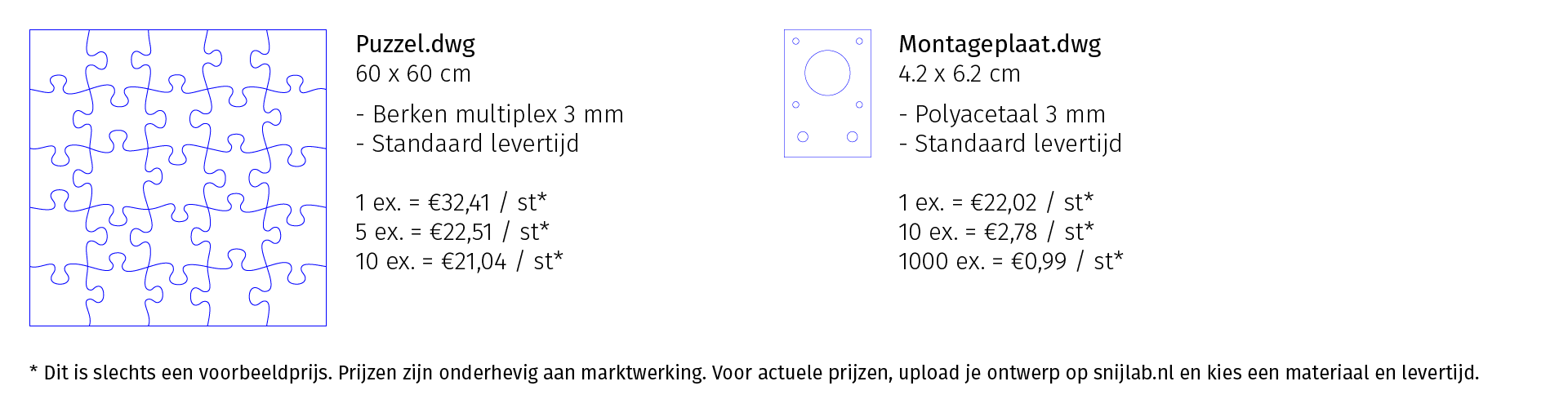
A single unique part can be yours for as little as €25, a large collection plate made from a valuable material can exceed €100, and a small part in a series can be laser cut for just €0.10, for example.
Compared to Other Techniques
In our article Laser Cutting in Larger Volumes, we already compared different production techniques regarding time to market, design freedom, suitability for prototyping, and suitability for producing larger volumes.

Regarding costs, there are, of course, also differences between the various production methods.
In this comparison, we assume you want to have something made according to your own design from wood or plastic. Are you using wood? Then milling and laser cutting are the only options, as 3D printing and injection molding wood are not possible.
3D Printing
For single small (<10cm) objects, 3D printing can sometimes be cheaper due to low setup costs. If you want more than one piece, the price per item for 3D printing usually doesn't get much cheaper. A large part of the cost lies in the production time, which does not decrease.
3D printing quickly becomes expensive for larger designs due to long production times. Laser cutting and milling are more suitable options then.
CNC Milling
Milling has slightly higher setup costs than laser cutting, and the process also takes longer. However, it offers advantages for large formats. It produces clean edges and allows for the creation of pockets (recesses).
Injection Molding
With injection molding, the mold (the hollow casting form) is usually the largest investment. The design and complexity of the part determine the cost of the mold, which can easily run into thousands of euros.
Snijlab Laser Cutting
With laser cutting, production itself is much faster, but there are slightly higher setup costs than with 3D printing. This means the price quickly decreases with larger volumes.
A single unique part can be yours for as little as €25, a large collection plate made from a valuable material can exceed €100, and a small part in a series can be laser cut for just €0.10, for example.
In short, there are a few areas where laser cutting always beats other techniques on price:
- Medium-sized (up to 1m) designs in wood and plastic
- Small (<20cm) objects in wood and plastic in series
How to Keep Laser Cutting Costs Low
Material Choice
Are you making a prototype? Then choose an affordable material like corrugated cardboard or MDF. Products can often be made from these materials as well.
Do you need wood? Then opt for thin materials <6 mm for Birch plywood. This is mechanically strong and relatively quick to process. For a thicker product, Poplar plywood might be more cost-effective. This depends on your design, so check it online.
Not too many different materials
You get a discount for each subsequent drawing made from the same material. Many of the setup costs have already been incurred, after all. That saves money. So, wherever possible, choose the same material for all your parts.
Smart Design
Don't draw unnecessary cut lines. See where you can make parts adjoin so they are separated by one line instead of two.
Choose a Cost-Effective Delivery Time
Choose a longer delivery time if you can wait a bit longer. This allows more time to process your order, making production more cost-effective.
More Pieces = Lower Costs
The first item is always the most expensive. Choose a larger run to spread the setup costs across more products.
Many Different Parts?
Combine them into one drawing. That saves on setup costs.
Extra Services Without Extra Costs
- An engineer checks your drawing before it goes into production
- Minimal smoke residue and shadow edges on your parts
- Quality control ensures 99%+ arrives correctly (we measure this continuously)
- Your part numbers clearly stated on delivery for quick implementation
- Free design consultation via video call
- Free advice on material selection
Do you want to know what it costs to produce your design using laser cutting at Snijlab? Request an online quote or order directly.